How to test perfume in store (and not get nose fatigue)
Most bad perfume buys start at the counter. How to test perfume in store properly: prep, paper strips to screen and skin for finalists, how many scents one visit can handle, what resets your nose, shopping with friends and the follow-up wear that decides the buy.

Most disappointing perfume buys start at the counter: six sprays on six strips, a nose that gave up after the third, and a bottle chosen on the strength of its first ten minutes. Learning how to test perfume in store fixes that. This guide covers the ten minutes of prep before you leave home, how to use paper strips and skin properly, how many fragrances one visit can really handle, what actually resets your nose (not the coffee beans), how to shop with friends, and the follow-up wear that should make the decision for you.
Key takeaways
- Paper strips are for screening. Skin is for finalists. Never buy from a strip alone.
- Screen three or four fragrances per round, rest, then stop at two rounds. Put no more than two on skin.
- Your nose adapts within minutes. Fresh air and time reset it. Coffee beans showed no special effect in the one study that tested them.
- Label every strip with the name and the time the moment it is sprayed.
- The real test happens after you leave: check your skin at 15 minutes, one hour, three hours and six hours.
- Shopping with one or two friends gives you a second nose and an honest distance check. You can post or find a perfume-shopping plan on PingMap's live map if your usual friends are not into fragrance.
- Buy on the second wear, not the first sniff.
In this guide
- Why in-store testing goes wrong
- Before you go
- How to test perfume in store, step by step
- Paper strips vs skin
- How many perfumes one visit can handle
- What resets your nose
- Testers, sales staff and samples
- Shopping with friends
- The follow-up wear
- How in-store testing changes by city
- Mistakes, troubleshooting and FAQ
Why in-store testing goes wrong
A perfume counter is a hard place to judge a perfume. Three things work against you at once.
- You are judging the opening. The first minutes of a fragrance are its brightest and most volatile part: citrus, fresh herbs, sparkling fruit and the sharp edge of the alcohol. What you live with for the rest of the day is the heart and the base, which often take half an hour or more to settle.
- The air is already full. A big fragrance hall is scented by hundreds of testers, the people who just used them and whatever the staff are wearing. Every strip you smell sits on top of that background.
- Your nose is adapting the whole time. Keep smelling, and your sensitivity drops. By the fifth or sixth strip, you are not comparing fragrances any more. You are comparing what is left of your attention.
None of this means you should stop testing in shops. A store is still the only place where you can smell twenty bottles for free in an afternoon. You just need a method that separates screening from deciding.
Before you go: ten minutes of prep
Knowing how to test perfume in store starts at home. A short list and clean skin save you from wandering the hall spraying anything with a nice bottle.
Build a short list of three to six
Decide what you are looking for in plain words: "a fresh scent for summer office days", "a warm vanilla for winter evenings", "something like my old favourite but less sweet". Then turn that into names. Use search by notes to list fragrances that include the notes you like and avoid the ones you know you dislike. If you already love one famous fragrance, a page such as perfumes similar to Baccarat Rouge 540 gives you neighbours to smell side by side with the original. Write the exact names, including the concentration, on your phone.
Arrive with neutral skin
- Skip your own fragrance that day. It will sit on your wrist and leak into every strip you hold.
- Use unscented or lightly scented deodorant, moisturiser and hair products if you have them. A strong body lotion is a fragrance too.
- Wear short sleeves or something you can push up. Your inner forearms are your testing space.
- Postpone the trip if you have a cold or blocked nose. You will be judging half a fragrance.
Pack three small things
- A pen, so you can write on strips.
- A paper envelope or a small zip bag, so you can carry strips home without them touching each other.
- A note on your phone with your list and a blank line for each fragrance.
Go at a quiet time if you can. A weekday morning in a department store means less crowded air and more patient staff than a Saturday afternoon.
How to test perfume in store, step by step
This is the routine that works whether you are in a vast department store, a small niche boutique or a pharmacy aisle. The same steps apply if you are working out how to test cologne in store, or how to test fragrances in store when the shelf is full of names you have never heard of.
Step 1: screen on paper
- Take a strip and label it first. Write the fragrance name and the time on the end you will hold. Unlabelled strips become a mystery within five minutes.
- One spray, from a short distance. Hold the tester about a hand's width from the tip of the strip and spray once. Two sprays do not tell you more; they just make the strip louder than its neighbours.
- Wait a few seconds. Let the alcohol flash off so your first impression is the fragrance, not the solvent.
- Waft, then sniff lightly. Wave the strip under your nose, then take two or three short sniffs. Do not touch your nose with it. Long, deep sniffs tire you faster.
- Write three words. "Bright lemon, soapy, sharp" is enough. Free words beat note lists, and they are how most people learn how to smell perfume notes over time.
Step 2: rest, then narrow to two
After three or four strips, step away from the counters for a couple of minutes. Then smell your strips again. Some will have softened into something better, some will have turned flat or sour. Keep the two you most want to smell again.
Step 3: put the finalists on skin
One spray on each inner forearm, a hand's width below the elbow crease, one fragrance per arm. Mark each spot with a small pen dot and note which is which. Do not rub. Then leave the counter.
Step 4: leave, and keep the strips
Put the strips in your envelope and get on with your day. The decision is made over the next few hours, not at the counter.
That is the whole routine for how to test perfume in store: paper to screen, a short rest, skin for two, and time to finish the job.
Paper strips vs skin: what each one tells you
Strips and skin answer different questions, so use both, in order.
How to test perfume on paper
Perfume testing strips (also called blotters) give every fragrance the same surface, the same dose and no body warmth. That makes them perfect for comparison and for screening many options quickly. Paper shows you the fragrance roughly as it was built, and it holds the base notes for hours, so a strip smelled the next morning tells you a lot about the drydown.
Paper has two limits. It does not warm the fragrance, so a scent can seem quieter or sharper than it will be on you. And it lacks your own skin scent, which is part of what other people will smell.
How to test perfume on skin
Skin is where you will wear it, so skin gets the final vote. Your warmth spreads the fragrance, your skin adds its own faint smell, and moisture and oils change how long it lasts. That is the usual answer to "why does perfume smell different on me than on the strip": the strip shows the formula, your arm shows the formula plus you.
Two fragrances on skin is the honest limit for one visit. More than that and the spots start to blend, especially in warm weather, and you will not know which arm smells of what by the afternoon. If you need a third, use the back of one hand, well away from the other two.
How to test perfume without strips
No strips at the counter? Ask; most fragrance counters keep them out of sight. If there really are none, a clean tissue or a plain paper napkin works for a quick sniff, though it holds the scent less evenly. Avoid spraying into the air and walking through the cloud: you smell mostly alcohol and you learn nothing about how it lasts. If you want a proper blind comparison at home later, our guide on how to run a blind fragrance test uses coded strips to take the bottle and the price out of your judgement.
How many perfumes can you test in one visit?
Fewer than you think. The practical limit is set by how fast your nose recovers, and there is real research on that.
A 2008 study in the Journal of Laryngology and Otology by Carl Philpott and colleagues measured how long 14 healthy volunteers took to return to their normal smell threshold after sniffing phenethyl alcohol, a rose-like test odour. The average was about 170 seconds, but individuals ranged from 81 seconds to 750 seconds, more than twelve minutes. For clinical retesting with that odour, the authors suggested waiting 15 minutes.
A perfume hall is not a clinic, and a fragrance is far more complex than one test odour. But the numbers support a simple rule of thumb:
- Per round: three or four strips.
- Between strips: a few relaxed breaths of normal air, and at least a minute or two.
- Between rounds: five to ten minutes away from the counters, ideally outside the fragrance hall.
- Per visit: two rounds, so six to eight strips in total, and two on skin.
- Stop signal: when the strips start to smell alike, you are done. Come back another day.
If your list is longer than eight, split it across two visits. It is the only way the last fragrance on your list gets the same chance as the first.
Nose fatigue: what resets your nose and what does not
Nose fatigue is the everyday name for olfactory adaptation: your sensitivity to a smell drops while you keep smelling it, then returns with time away. It is normal, and it happens to professional perfumers too. You cannot prevent it; you can only manage it.
About the coffee beans
Many counters offer a jar of coffee beans to "reset your nose". The coffee beans perfume myth has been tested. Sensory psychologist Avery Gilbert, writing on his blog First Nerve in 2011, described a study by Alexis Grosofsky and colleagues at Beloit College, published in Perceptual and Motor Skills. Participants smelled three perfumes, then sniffed coffee beans, lemon or plain air, and then tried to pick out a new fourth perfume. The differences between the three were not statistically significant, and the authors concluded that coffee beans and lemon seem to have no special refreshing properties.
Coffee is also a strong, complex smell in its own right: one more fragrance for a nose that is already busy.
What does help
- Time and plain air. Step outside the fragrance hall, or at least to a quieter corner, and breathe normally for a few minutes.
- Fewer sniffs. Two or three short sniffs per strip. Knowing how to sniff perfume is mostly knowing when to stop.
- Smelling your own unscented skin. Many people sniff the inside of their elbow or a cotton sleeve between strips. There is no evidence it beats fresh air, but it does no harm and keeps you away from the testers for a moment.
- Revisiting rather than re-spraying. When you are unsure, smell the strip again after a rest. A new spray only adds more of the opening.
Testers, sales staff and samples
Half of knowing how to test perfume in store is handling the counter. A few perfume shopping tips that experienced buyers use:
- Say what you want to do. "I'd like to smell these three on paper first, please" is clear and polite. Most staff are happy to hand you strips and step back.
- Decline the spray-down. If someone offers to spray your wrists, neck and both arms with four different things, say no. You will smell a blend, not a fragrance.
- Read the label on the tester. Many lines exist as an eau de toilette, eau de parfum, parfum and a string of "intense" or "elixir" versions that smell different. Photograph the tester so you know exactly what you smelled. If you are torn between two versions of one line, a page such as Bleu de Chanel EDT vs EDP side by side shows how the community rates each one before you go back.
- Be wary of tired testers. Perfume testers sit under bright lights on warm counters and get handled all day. Heat and light can change a fragrance over time, especially its fresh top notes. If a tester smells oddly flat or sour, ask whether there is a newer one.
- Ask about a sample. Policies vary by store, brand and country. Some counters will decant a small sample from a tester or hand you a sealed vial; others cannot. It never hurts to ask once, politely, after you have shown real interest. Knowing how to try perfume samples properly matters too: wear each one on a normal day, not alongside three others.
Good sales staff will suggest things you had not considered. Smell their suggestions on paper first; a strip keeps your skin free for the finalists.
Shopping with friends: two noses, one plan
Testing perfume alone works. Testing with one or two people works better, for three practical reasons.
- You get to smell it on someone else. Ask a friend to wear your finalist on their arm. You cannot judge your own projection, but you can smell what a fragrance does on another person from a normal conversational distance. That is close to what other people will notice on you.
- You get an honest distance check. After an hour, ask your friend whether they can smell your arm from across a café table. It is the simplest way of learning how to test perfume projection without any equipment.
- You test twice as many on skin. Two people, two arms each, four finalists, and you can swap sniffs all afternoon.
Agree the rules before you start: each person screens their own list on paper, nobody sprays anyone without asking, and nobody talks up a strip until everyone has written their three words. Opinions are contagious. A friend saying "ooh, that one smells expensive" changes what you smell next.
If your usual friends find fragrance shopping baffling, you do not have to go alone. You can post a perfume counter plan and approve who joins, keep it to two or three people, and meet in the store or a café, which is where you were going anyway. Before you post, look at PingMap's Exact, Safe and Ghost presence modes, which decide how precisely you appear on the map while you wait.
Setting up a perfume-shopping plan on PingMap
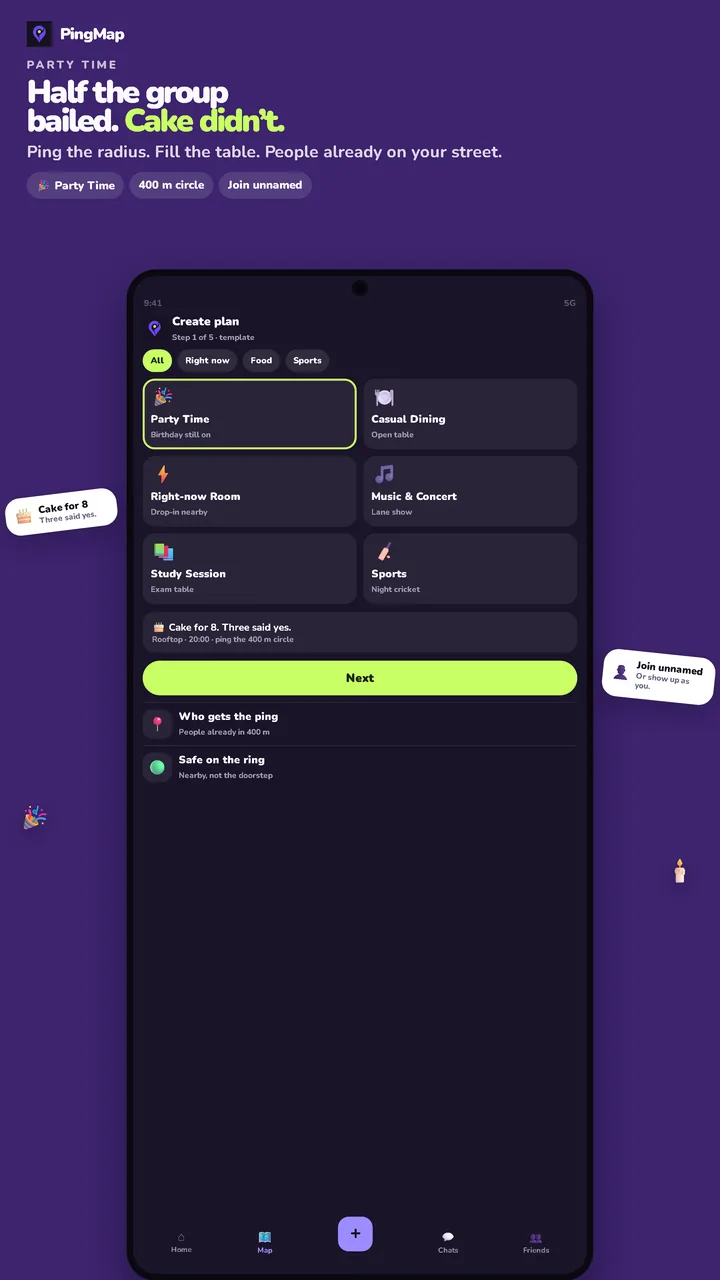
PingMap is a web app built around a live map of plans nearby. You sign in with Google (it is for adults, 18 and over), create a plan with a time and a place, and people within your radius can find it and ask to join: 10 km on the free plan, 50 km with Premium. A plan for a perfume trip might read: "Saturday 11am, three fragrance counters on the high street, strips first, coffee after. Max three people."
Each plan has its own room for chat, and that is where a group's prep belongs. Here is how PingMap plan rooms keep a group's shortlist in one chat: everyone drops their list of names, the stores, the meeting point and the order of the route. If you would rather start from a ready-made structure, there are quick plan templates for small groups for food, outdoor and general meetups that adapt easily to a shopping morning.
If the trip works, repeat it. A monthly fragrance outing, each person bringing one sample to share, is the easiest way to keep learning, and the guide on how to turn a one-off outing into a regular hobby club covers the dull but useful parts: a fixed day, a simple format and a way to welcome newcomers. When people start bringing decants, our guide on how to run a fragrance swap meetup covers labelling and decanting safely.
The follow-up wear: decide outside the store
If you remember one thing about how to properly test perfume, make it this: the store is for screening, and the follow-up wear is the test. This is how to test perfume before buying in a way that predicts whether you will still like it in a month.
A four-checkpoint log
- 15 minutes: the opening has mostly gone. Is the heart what you hoped for?
- One hour: the fragrance has settled. This is roughly how it smells for most of the day. Ask someone nearby whether they can smell it.
- Three hours: the drydown. Many fragrances change character here: sweeter, woodier, muskier. Some fall apart.
- Six hours, or when it disappears: note the time you last noticed it. That is your first rough reading of how to test perfume longevity on your own skin.
Write a line at each checkpoint, so you do not remember only the opening. Then compare your notes with the community votes on the longevity leaderboard or the fragrance's own page. A big gap between your skin and the crowd is a reason for a second test, not a verdict.
Smell the strips the next morning
Your strips from yesterday are now pure base notes. Smell them side by side. It is often the clearest view you get of what a fragrance leaves behind on a scarf or a jacket collar.
Wear it a second time, somewhere different
One wear is a snapshot. A second wear on a different day, in different weather, tells you whether the first impression was the fragrance or the mood. If you shopped with friends, compare logs over a coffee the next day. You can open the live map of plans within 10 km and set the follow-up as a short plan of its own, so the second wear gets a second opinion too.
If it still makes you happy at the three-hour mark on the second wear, buy it. If you are lukewarm, you have saved the price of a bottle.
How in-store testing changes by city
The method stays the same everywhere. What changes is the shop format, the climate you will wear the fragrance in and the local sense of how much scent is too much. Seven very different places show the range.
Paris: the department store beauty hall
Parisian department store beauty floors are huge. Galeries Lafayette Haussmann reopened its reworked beauty space in 2026 across three floors, with trade reports putting it at about 450 brands. In a hall that size the air itself is perfumed, so the three-or-four-per-round rule matters more than anywhere. Smell your strips again once you are out on the street; many of them will seem quite different away from the background.
London: high street and grey skies
London puts department store halls, chain perfumeries and niche boutiques within a short walk of each other, which suits the two-visit approach. The climate is mild and damp for much of the year, so do the one-hour check outside rather than in a warm shopping centre.
New York: heated stores, cold streets
In a New York winter you move between overheated stores and freezing pavements. Heat makes a fragrance louder; cold makes it quieter and closer. A scent that seems perfect in a warm flagship store may disappear outdoors, and a heavy amber that felt cosy inside can be a lot on a hot subway platform in July. If you buy in one season, plan a second wear in the other before you commit to a large bottle.
Dubai: oud, oils and the perfume souk
Oud is central to perfume shopping across the UAE, and Dubai offers both modern malls and a traditional perfume souk in the old town. Many shops sell concentrated perfume oils alongside sprays, and clothes are often scented with bakhoor smoke at home. Oils are applied by touch rather than sprayed, sit close to the skin and can last a long time, so one oil per arm is plenty. Do the one-hour check outdoors too: the step from a chilled mall into the heat changes how a fragrance behaves.
Tokyo: subtle by default
Japan has a word, sumehara or "smell harassment", for imposing smells on people around you, including too much perfume. In August 2021 five Japanese government bodies, among them the Consumer Affairs Agency and the Ministry of the Environment, issued a poster asking people to consider that a scent might be bothering someone nearby, and the campaign has since been reissued with more agencies behind it. Some restaurants where aroma matters go further: one udon shop in Beppu posted house rules turning away diners wearing strong artificial fragrance. When testing in Tokyo, judge a finalist by the crowded-train test: could a person standing next to you smell it? If the answer is a clear yes, it is probably an evening or weekend scent there.
Mumbai: attar counters and humid heat
In Mumbai you can test international releases in air-conditioned malls and traditional attars, oil-based perfumes without alcohol, at specialist sellers. Attars are dabbed, not sprayed, and a little goes a long way. The humid heat outside makes most fragrances bloom, so a scent that felt polite under the mall air conditioning can become much louder by the afternoon. Treat the one-hour outdoor check as essential, and favour one spray over two.
São Paulo: test on different days
Brazil has long been reported as one of the world's largest fragrance markets (Euromonitor even ranked it ahead of the US in 2010), with home-grown brands such as Natura and O Boticário holding a large share. Much of that market is sold through consultants and brand stores rather than big department halls, so in São Paulo you often test in small branded shops in malls and shopping streets. That suits the method: it is easy to smell the same fragrance at a different branch on a different day, which is exactly what a second wear needs.
Wherever you shop, the social side works the same way. PingMap, a live map for local plans, works wherever people use it, so a fragrance outing posted on a quiet afternoon can bring in a second nose from the neighbourhood.
Common mistakes
- Buying in the first ten minutes. You are buying the opening. Wait at least until the one-hour check, ideally until the second wear.
- Too many on skin. Four fragrances on two arms becomes one fragrance by lunchtime.
- Unlabelled strips. "The third one" means nothing after a coffee break. Name and time, every time.
- Rubbing your wrists together. It does not help, and it spreads the fragrance to your hands.
- Wearing your own perfume to the shop. It sits under every strip you hold.
- Letting the bottle and the brand decide. A heavy cap and a famous name change what you expect to smell. Judge the strip before you look at the price tag.
- Testing only in the store's climate. Air conditioning and central heating hide what the fragrance will do in your real weather.
If this happens: troubleshooting
Everything started to smell the same
Your nose has adapted. Stop, leave the fragrance hall for ten minutes and breathe normal air. If it does not clear, end the visit and smell your strips again at home.
Someone sprayed you with four things at once
Wash the spots with soap and water if you can, or at least note which arm got what. Treat that visit as screening only and repeat the skin test another day.
The fragrance vanished within an hour
Check whether you tested a lighter concentration than you thought, and whether the tester was old. Then compare with the longevity votes before writing it off; your skin may simply be a fast evaporator, and the fix may be a richer version of the same line.
It smelled great in the store and odd at home
The background in the store was masking something, or the drydown is where the fragrance lost you. Smell the strip and your skin side by side. If the strip still smells good and your skin does not, the fragrance may not suit your skin, and that is useful to know before buying.
Your skin went red or itchy
Wash the area with soap and water and do not test that fragrance on skin again. Stick to strips for that one, and mention it if you see a doctor about skin reactions.
You liked two equally
Wear each one alone on separate days. If they still tie, open a side-by-side compare and decide on the things your nose cannot settle: which one lasted longer on you, and where you would actually wear it.
FAQ
How do you test perfume in a store?
Screen on paper first: label a strip, spray once, wait a few seconds, then waft and sniff lightly. Smell three or four per round and rest for a few minutes between rounds. Put your two favourites on skin, one per inner forearm, then leave the store. Check your skin at 15 minutes, one hour, three hours and six hours, and buy only if you still like it on a second wear.
How many perfumes can you test at once?
Three or four per round is a sensible limit, with a few minutes of fresh air between rounds and no more than two rounds per visit. Smell adaptation research found that recovery after one test odour took about three minutes on average and up to twelve minutes for some people, so longer lists blur together. Put no more than two fragrances on skin.
Should you test perfume on paper or skin?
Both, in that order. Paper strips are the fair way to screen several fragrances because each gets the same surface and dose. Skin adds your warmth and your own scent, which is what other people will smell, so skin decides. Never buy from a strip alone, and give the skin test a few hours.
Do coffee beans really help when testing perfume?
Not according to the one study that tested it. Researchers at Beloit College had people sniff coffee beans, lemon or plain air between perfumes and found no significant difference in how well they picked out a new scent. The authors concluded coffee beans have no special refreshing properties. Time away from the counters and plain air are the reliable reset.
Why does perfume smell different on me than on the strip?
Paper shows the formula on a neutral, cool surface. Your skin is warmer, has its own faint smell, and its moisture and oils change how fast each part of the fragrance evaporates. The result can be sweeter, sharper, quieter or shorter-lived than the strip suggested. That is why skin always gets the final vote before you buy.
How long should you wait before buying a perfume you tested?
At least until the drydown, which means a few hours on skin. Better still, wear it a second time on a different day and in different weather. A fragrance that still pleases you at the three-hour mark on the second wear is a far safer buy than one you loved in the store's first ten minutes.
Where can I test perfumes besides a department store?
Niche boutiques, chain perfumeries, pharmacies with fragrance aisles, brand stores and, in many cities, traditional attar or oud shops. Samples, decants and discovery sets let you test at home; how to test perfume samples is the same follow-up wear, one sample per day. Swap meetups let you smell other people's collections. Small group outings help too, and there are plan ideas for your neighbourhood that turn a shopping trip into a shared one.
Your next perfume counter trip
Pick three to six names, arrive with clean skin and a pen, screen on paper in rounds of three or four, put two on skin, and walk out. Log your checkpoints, smell the strips the next morning and wear the winner a second time before you pay. That is how to test perfume in store without letting a tired nose, a loud tester or a persuasive bottle make the decision for you, and it is the most reliable way of learning how to choose a perfume that suits you rather than the person at the counter.
When you get home, look up your finalist's notes and explore its family in the accords explorer. If it is a widely worn scent like Dior Sauvage, smelling it on yourself in a few settings matters even more, because you will meet it on other people too. If the fragrance is going to work, read our notes on office safe fragrances and shared-space etiquette before your first Monday wear. More guides are on the Fragranxe blog.
Comments